
Leading vs lagging indicators
Educational only. This primer sorts macro data into leading, coincident, and lagging labels. It is not a forecasting system, not a recession timer, and not advice to trade calendars.
Site vs Telegram
Indicator taxonomy lives here. When a busy data week hits, plain-English decoding belongs on Telegram: Macro Simplified on Telegram.
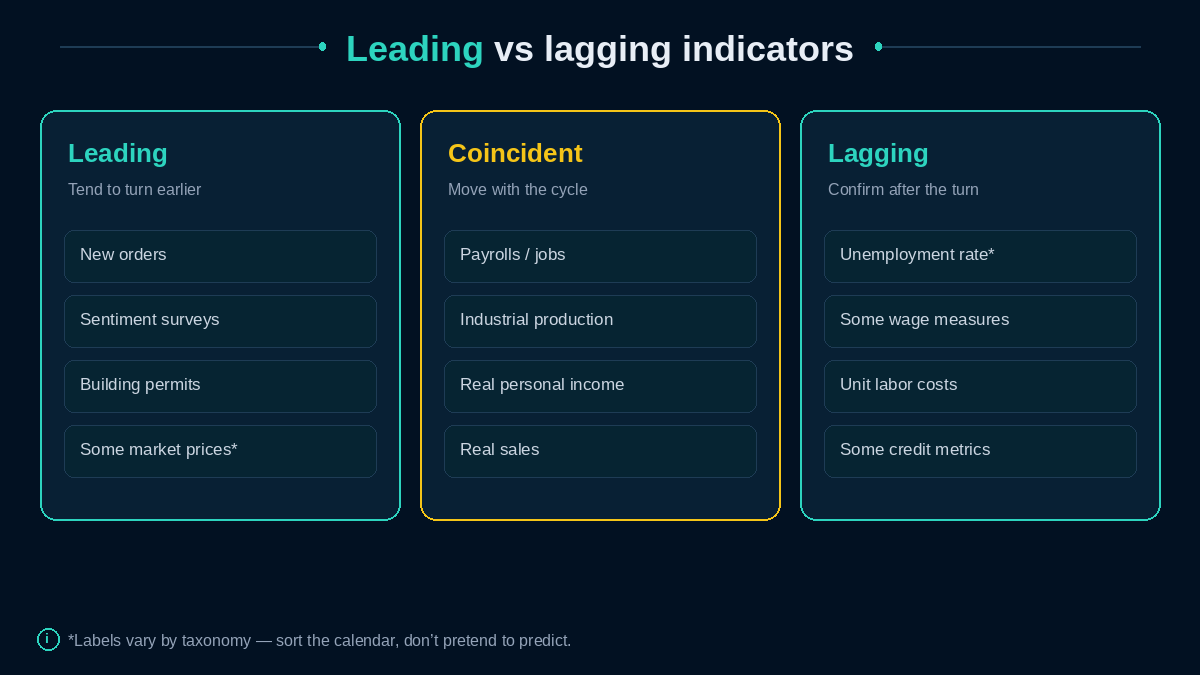
Diagram: Sort the calendar — leading / coincident / lagging vocabulary, not a prediction engine.
Why the calendar feels noisy
Beginners see PMI surveys, payrolls, CPI, claims, housing starts, and GDP all in one month and wonder which one “is the economy.” A classic teaching sort helps:
- Leading — tend to turn earlier than broad activity (orders, some surveys, permits, some market prices)
- Coincident — move roughly with the cycle (jobs, industrial production, real income, real sales)
- Lagging — confirm after the turn (unemployment rate in many taxonomies, some wage and credit metrics)
Taxonomies differ by textbook and institute. Treat the buckets as habits for reading, not sacred law. Pair with Sources and habits and the Event playbook.
Leading — early whispers (with false alarms)
Leading indicators try to sniff turning points early: new orders, sentiment surveys, building permits, and sometimes financial-market prices. Strengths: timeliness. Weaknesses: noise and false signals. A soft survey does not automatically equal a recession call—see Recession vocabulary.
Markets are not official leading indexes, but prices often move on expectations (Priced in / expectations). That still is not a license to treat every tick as destiny.
Coincident — the “where are we now?” layer
Payrolls, industrial production, and related activity gauges often sit closer to “current temperature.” Even here, revisions matter and single prints mislead. GDP is quarterly and revised—see GDP and measurement. Jobs detail lives in Jobs and growth.
Lagging — confirmation, not steering
Lagging series confirm what already happened. The unemployment rate can keep rising after a trough in activity; some wage measures roll over late. Lagging does not mean “useless.” It means “don’t use me as your only early-warning siren.”
A calm sorting habit
- Label the release: leading / coincident / lagging (best guess).
- Ask what question it answers (orders? jobs? prices?).
- Check surprise vs expectation (Priced in / expectations).
- Place it on the business cycle map without dating the peak.
This habit lowers panic without pretending you can predict. For inflation microstructure, see Sticky services and shelter inflation; for policy reaction functions, Dual mandate.
Common confusions
- “Leading indicators never fail.” They fail often enough that humility is part of literacy.
- “Lagging means ignore it.” Confirmation still shapes policy and narratives.
- “One hero series replaces the dashboard.” Macro is a panel, not a single gauge.
- “Sorting indicators = a trading system.” Not on this site.
In practice — a sample week
Suppose the week holds: a soft manufacturing PMI (leading-ish), solid payrolls (coincident), and a still-elevated unemployment rate vs last year’s low (lagging-ish in many maps). The sorted reading is mixed, not “the economy is X.” That sentence alone is progress.
Add inflation and the policy path only after the activity sort—otherwise every release feels like a referendum on the same question.
How this connects
- Business cycle · Recession vocabulary
- Jobs and growth · GDP and measurement
- Event playbook · Sources and habits
- How to read macro
Related reads
Telegram
Busy data weeks: Join Macro Simplified.