
Fiscal policy basics
Educational only. This primer explains fiscal vocabulary for learning. It is not a political endorsement, not a campaign argument for higher or lower taxes or spending, and not financial advice or a trade idea tied to any budget outcome.
Site vs Telegram
Durable fiscal-vs-monetary basics live here. Live decoding when data or Fed days interact with the fiscal debate belongs on Telegram: Macro Simplified on Telegram.
Macro headlines mix two big policy worlds: what elected governments do with budgets, and what central banks do with interest rates and liquidity. Separating those worlds keeps debates clearer—and keeps this page educational rather than partisan.
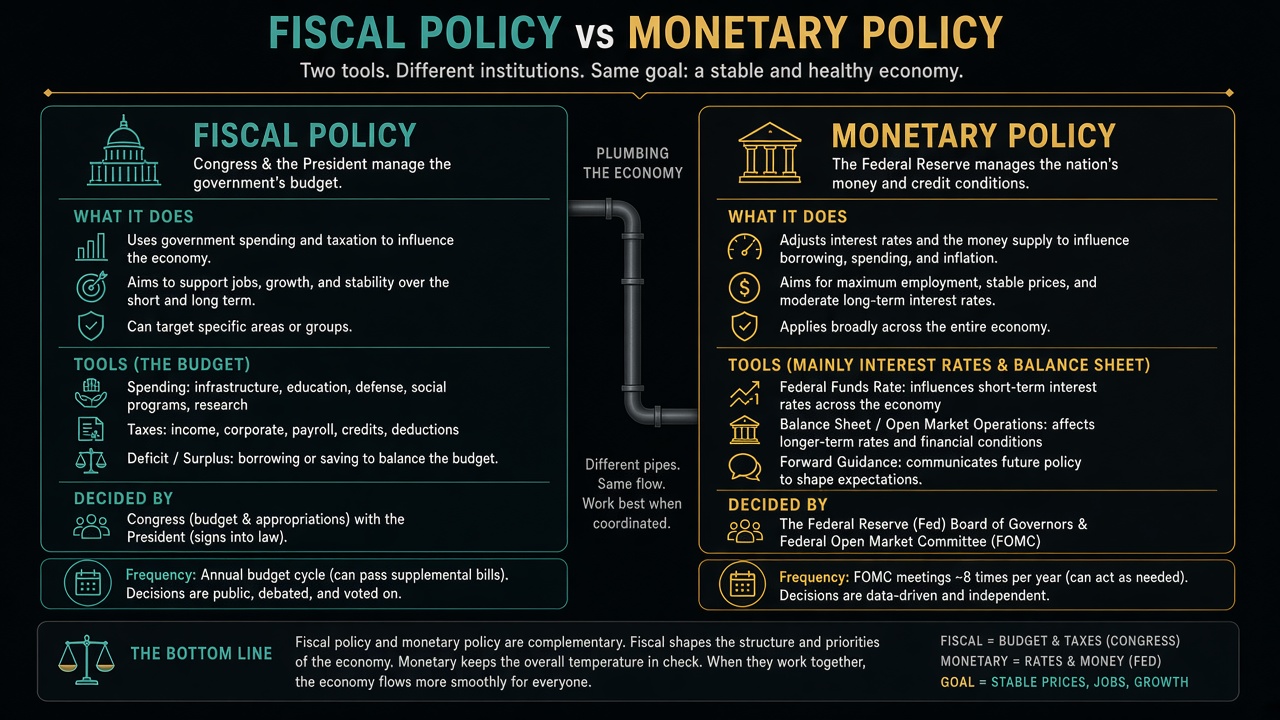
Diagram placeholder: fiscal levers vs monetary levers — teaching contrast only.
Spending, taxes, deficits, and debt (plain English)
Fiscal policy is how a government collects money and spends it.
Spending
Outlays on public services, transfers (like social benefits), interest on existing debt, and investments in infrastructure or other programs. More spending, all else equal, injects demand into the economy; less spending withdraws demand. “All else equal” rarely holds in real life—timing, composition, and confidence matter.
Taxes
Income, payroll, corporate, sales, and other levies. Higher taxes, all else equal, pull purchasing power from households and firms; lower taxes leave more purchasing power in private hands. Composition matters here too (who is taxed, and on what).
Deficit and surplus
When spending exceeds tax and other receipts over a period, the government runs a fiscal deficit. When receipts exceed spending, it runs a surplus. Deficits are common in downturns (taxes fall, some spending rises) and can also reflect deliberate policy choices in expansions.
Debt
The stock of what the government owes from past borrowing—accumulated deficits minus past surpluses, plus other financing details. A deficit is a flow (this year’s gap); debt is a stock (the pile so far). Headlines often blur the two; keeping them straight is half the literacy battle.
This site states those definitions neutrally. Whether a given deficit is “too large” or “appropriate” is a political and economic judgment Macro Simplified does not campaign for.
How fiscal differs from monetary (the Fed)
| Fiscal policy | Monetary policy | |
|---|---|---|
| Who | Congress, Treasury, and the broader elected government | The Federal Reserve (independent within its mandate) |
| Main levers | Taxes, spending, borrowing | Policy rate, balance sheet (QE/QT), forward guidance |
| Feel in daily life | Tax refunds, benefits, public projects, deficit debates | Loan rates, mortgage quotes’ environment, financial conditions |
| Primer | This page | The Fed toolkit |
The Fed does not vote your tax rates or write the annual budget. The government does not set the federal funds rate. Markets still react when either side surprises—because both shape demand, inflation pressure, and the supply of bonds investors must absorb.
A useful metaphor: fiscal policy is more like deciding how much the public sector adds to or subtracts from demand; monetary policy is more like adjusting the cost and plumbing of money and credit. Both can ease or tighten financial conditions in different ways. Neither is a remote control for stock or crypto prices.
Why deficits show up in macro debates
Deficits enter the conversation for a few recurring reasons—presented here as topics people argue about, not as verdicts:
- Demand and inflation. Large stimulus when the economy is already hot can add to inflation pressure in textbook stories; austerity when the economy is weak can deepen a downturn. Real episodes are messier (supply shocks, lags, global factors). Link lightly: Inflation 101.
- Bond supply and yields. Heavier government borrowing means more bonds for markets to buy. That can interact with yield levels and with how the Fed’s balance-sheet policy is evolving—see Interest rates and yields.
- Crowding-out vs crowding-in arguments. Some commentators worry deficits soak up private savings or push rates higher; others emphasize productive public investment or support in a slack economy. You will hear both; this primer names the debate without picking a team.
- Sustainability and confidence. Long-run questions about debt paths affect risk premia and political risk narratives. Those are slow-moving stories—not day-trading cues.
When deficits dominate the news, ask: is the speaker talking about near-term demand, bond-market supply, or long-run sustainability? Different frames, different time horizons.
Careful neutrality (how we write this)
- We explain mechanisms and vocabulary, not which party’s plan is correct.
- We avoid “should” language about tax rates or program sizes.
- We do not translate budget bills into buy/sell lists for bonds, stocks, or crypto.
- We link fiscal talk to inflation and rates only as context channels, matching the educational tone of Risk assets 101.
If a reader wants advocacy, that lives elsewhere. Macro Simplified stays a learning desk.
How this connects to the rest of the curriculum
Fiscal and monetary stories meet in the business cycle: expansions and contractions change automatic tax receipts and some spending, while discretionary packages can amplify or offset the cycle. Fed officials still watch inflation and jobs under the dual mandate regardless of the fiscal backdrop—see Jobs and growth.
On event days, fiscal headlines sometimes share the screen with FOMC or CPI. Keep the Event playbook process; use Telegram for same-day language.
Related reads
Telegram
Live macro decoding (still educational, not political campaigning): Join Macro Simplified.