
Bubbles and feedback loops
Educational only. This primer explains bubble and feedback language. It is not a short recommendation, not a call that “X is a bubble today,” and not a timing system.
Site vs Telegram
Concept maps live here. When bubble talk floods the timeline, Telegram keeps the tone educational: Macro Simplified on Telegram.
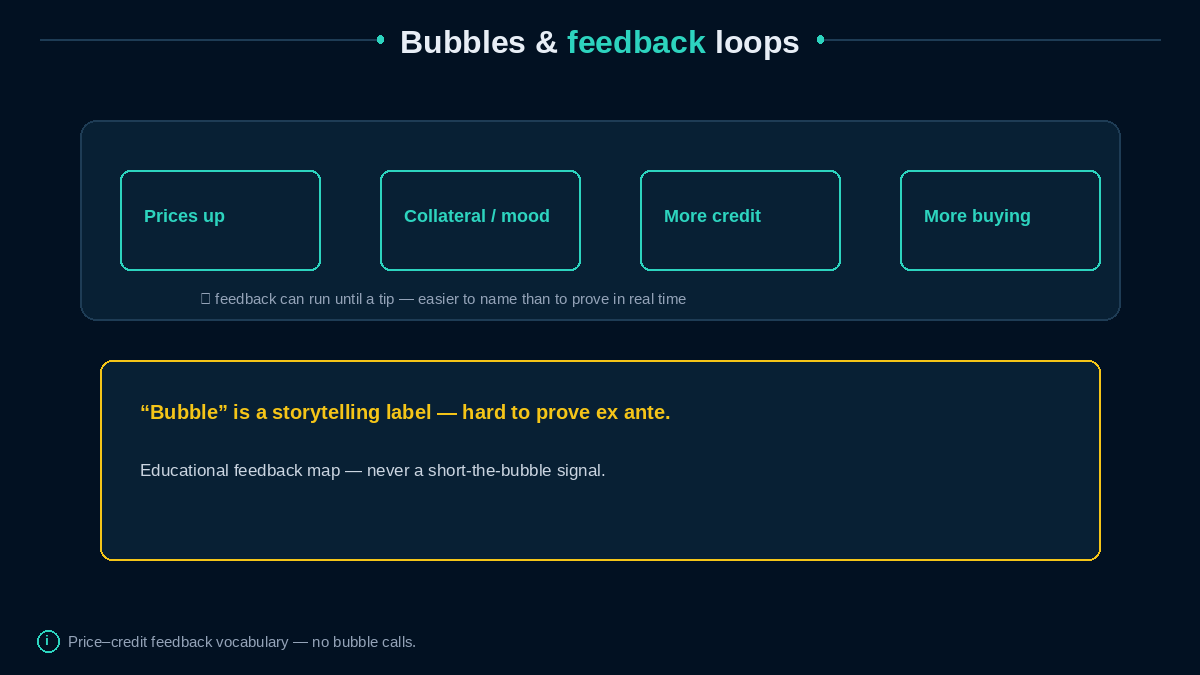
Diagram: Prices up → collateral/mood → more credit → more buying — easier to name than to prove.
Feedback in plain English
A feedback loop exists when rising prices improve collateral and mood, which expands credit, which finances more buying, which lifts prices again—until something breaks. The reverse loop runs in crashes: falling prices tighten credit and force sales (Credit cycles, Debt and leverage).
Bubble is the storytelling label for prices supposedly detached from fundamentals and driven mainly by self-reinforcing expectations. The label is easy; proof in real time is hard.
Why “bubble” is slippery
Fundamentals are disputed. Credit conditions change. Narratives run ahead of data (Risk, luck, and narratives, Priced in / expectations). Many true bubbles were argued about for years; many false alarms also used the word.
This site’s rule: teach the feedback mechanism; refuse to certify live bubbles.
Where macro meets the word
Housing–credit loops, equity–margin loops, and crypto–liquidity loops all borrow the same template (Housing, mortgages, and rates, Crypto and macro liquidity). Policy rates and financial conditions alter the fuel (Monetary policy transmission, Financial conditions).
Crisis vocabulary covers the break phase (Financial crises vocabulary).
Common confusions
- “High valuation = proven bubble.” Valuation debates ≠ completed proof.
- “If I say bubble, I must short.” Not on this site—ever.
- “Feedback only exists in manias.” Mild feedback exists in ordinary cycles too.
- “One influencer thread settles it.” Demand mechanisms and data.
In practice
Replace “it’s a bubble” with: What is the credit channel? What narrative is self-reinforcing? What would count as contrary evidence? That rewrite is the educational product (Sources and habits).
Credit is not required for every speculative episode, but leverage usually makes feedback faster and crashes deeper. That is why debt capacity, covenant quality, and margin rules show up in serious post-mortems (Debt and leverage). Narratives without credit can still run; narratives with credit often matter more for macro.
Policy responses after breaks—liquidity facilities, guarantees, reforms—shape the next cycle’s risk-taking. Moral-hazard debates belong in crisis vocabulary (Financial crises vocabulary); this page only notes that feedback loops are partly institutional.
Cross-asset loops (housing collateral supporting consumer credit, or equity wealth affecting spending) extend the template into real-economy demand (Consumption and saving).
Ex post, many episodes look obvious; ex ante, sincere experts disagree. Build that humility into your language: “feedback looks extended” is safer educational phrasing than “certified bubble.”
Watch for in headlines: leverage-fueled price spikes, collateral spirals, and confident bubble certificates. Prefer feedback-mechanism language and contrary-evidence tests.
Media amplification is itself feedback: rising prices attract coverage that attracts new buyers. Recognizing media feedback does not require cynicism about all journalism—just caution about extrapolative stories. Humility about labels is part of the curriculum promise.
How this connects
- Credit cycles · Debt and leverage
- Financial crises vocabulary · Risk, luck, and narratives
- Diversification and regimes · Risk assets 101
Related reads
Telegram
Bubble-talk headline days: Join Macro Simplified.