
Risk assets 101
Educational only. This primer explains vocabulary and mechanisms. It is not a signal to buy or sell stocks, crypto, or any other asset, not a timing system, and not personalized investment advice.
Anti-signal framing (read this twice)
Macro helps you understand the weather around risk markets. It does not tell you when to enter or exit. Nothing on this page is a trade idea, price target, or “you should position” suggestion.
Live event context (still not signals) lives on Telegram: Macro Simplified on Telegram.
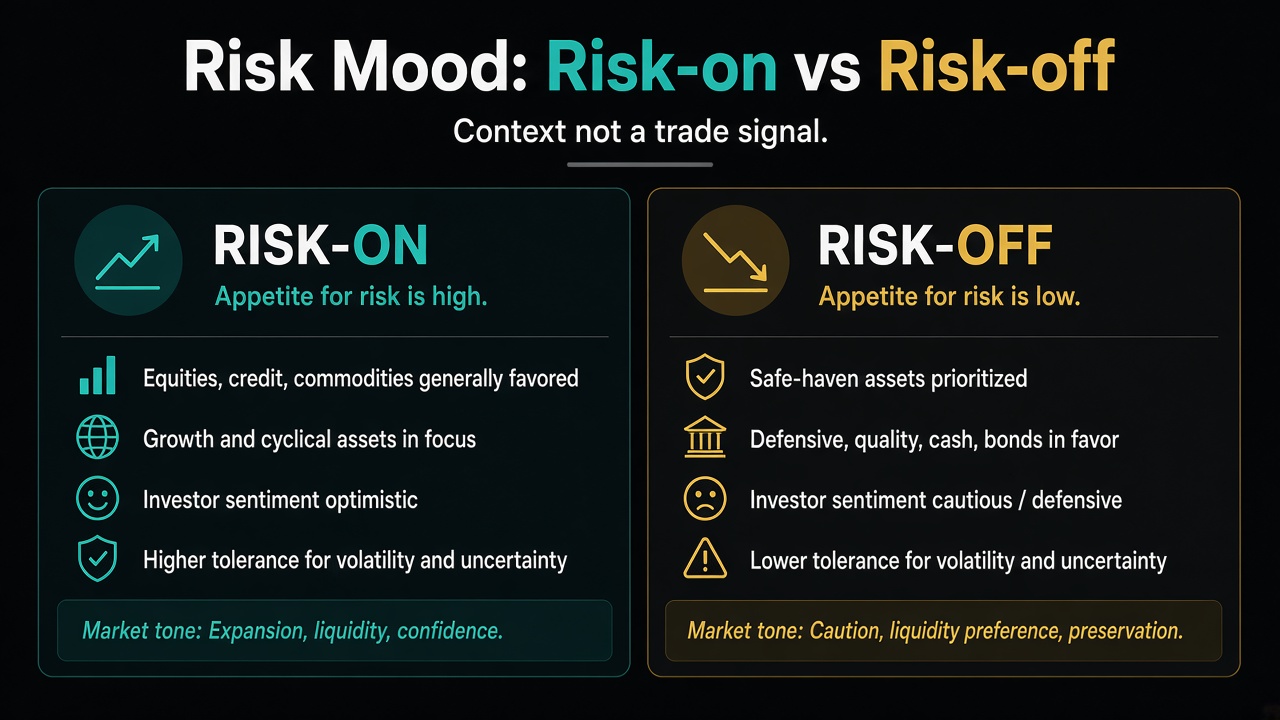
Diagram placeholder: risk mood as context weather — not a buy/sell light.
What risk assets means here
In macro conversation, risk assets is a loose umbrella for investments that tend to do better when investors feel optimistic about growth and liquidity—and worse when fear or tighter financial conditions take over. Common examples people lump in: equities, credit that is not the safest government debt, and many crypto assets.
The contrasting mood label is often risk-off: a preference for safety, cash, or assets seen as hedges when uncertainty spikes. Neither label is a moral judgment. They are shorthand for appetite.
Important beginner corrections:
- “Risk asset” is not a promise of high returns.
- Not every stock or token moves together every day.
- Macro is one input among many (company news, regulation, tech cycles, positioning).
This site uses the phrase so you can follow headlines that say “risk assets rallied on cooler inflation” without assuming that sentence is a recommendation.
Rates and discounting (light)
When interest rates rise, future cash flows—profits, coupons, or speculative payoffs years out—are often discounted more heavily in valuation stories. In plain English: money later is worth less relative to money now when rates are higher, all else equal.
That “all else equal” does a lot of work. Growth expectations, inflation paths, and risk appetite can swamp a simple rates story on any given week. Still, the light version is useful:
- Higher policy rates / tighter financial conditions can weigh on long-duration optimism.
- Lower rates / easier conditions can support appetite for assets that need a longer runway.
This is mechanism, not a rule that “rates up → always sell.” Crypto and equities have risen and fallen in many rate regimes. Learn the channel; do not enshrine it as a timing switch. For how the Fed moves the policy rate and talks about the path, see The Fed toolkit.
Liquidity and risk mood
Liquidity in macro slang often means how easy it is for money and credit to flow through the system—bank reserves, market functioning, willingness to lend and take risk—not merely “can I sell my coin in two seconds.”
QE and QT (covered lightly in the Fed toolkit) change the plumbing of reserves. Separately, private credit conditions and market volatility change how freely investors want to lean into risk. When liquidity feels abundant and stable, risk mood often improves. When liquidity feels scarce or fragile, risk-off behavior shows up more often.
Again: correlation is not a trading algorithm. Liquidity is one lens for why risk assets might feel bid or offered in a given regime—not a green/red light for orders.
Crypto’s macro sensitivity (not a trading rule)
Crypto markets can be macro-sensitive: they sometimes react hard to FOMC decisions, inflation surprises, and shifts in dollar liquidity or risk appetite. That sensitivity is why crypto-curious readers land on macro education in the first place.
Hold these boundaries tightly:
- Sensitivity ≠ a reliable hedge against inflation every month.
- Sensitivity ≠ “always follows the Nasdaq” or “always follows gold.”
- A macro print that moves Bitcoin one morning can be ignored the next week when crypto-native news dominates.
Use macro to explain episodes (“liquidity fears rose after X”). Do not turn this paragraph into a rule like “buy crypto when CPI cools.” That would be the opposite of this site’s educational promise.
Use macro to understand not to time
A healthy learning loop looks like this:
- Read a durable primer (How to read macro, Fed, inflation, jobs).
- On event day, follow process in the Event playbook and the Telegram decode.
- Ask: What did the data say about demand, inflation, and the Fed’s trade-offs?
- Ask: How might that change financial conditions or risk mood?
- Stop before inventing an entry or exit.
If a sentence on this site ever feels like it is pushing you to act in a market, re-read the disclaimer—the intent is comprehension only.
Related primers
- How to read macro — habits before headlines
- The Fed toolkit — rates, balance sheet, guidance
- Inflation 101 — why price data moves the policy debate
- Jobs and growth — labor and landing language as scenarios
- Event playbook — calm process on print days
- Glossary — liquidity, risk-off, and more
Related reads
Telegram
Event-day context without turning primers into signals: Join Macro Simplified.