
Long-run growth and productivity
Educational only. This primer explains long-run growth concepts. It is not a stock-picking guide, not a productivity trade, and not personalized advice.
Site vs Telegram
Long-run explainers live here. Cyclical print decoding belongs on Telegram: Macro Simplified on Telegram.
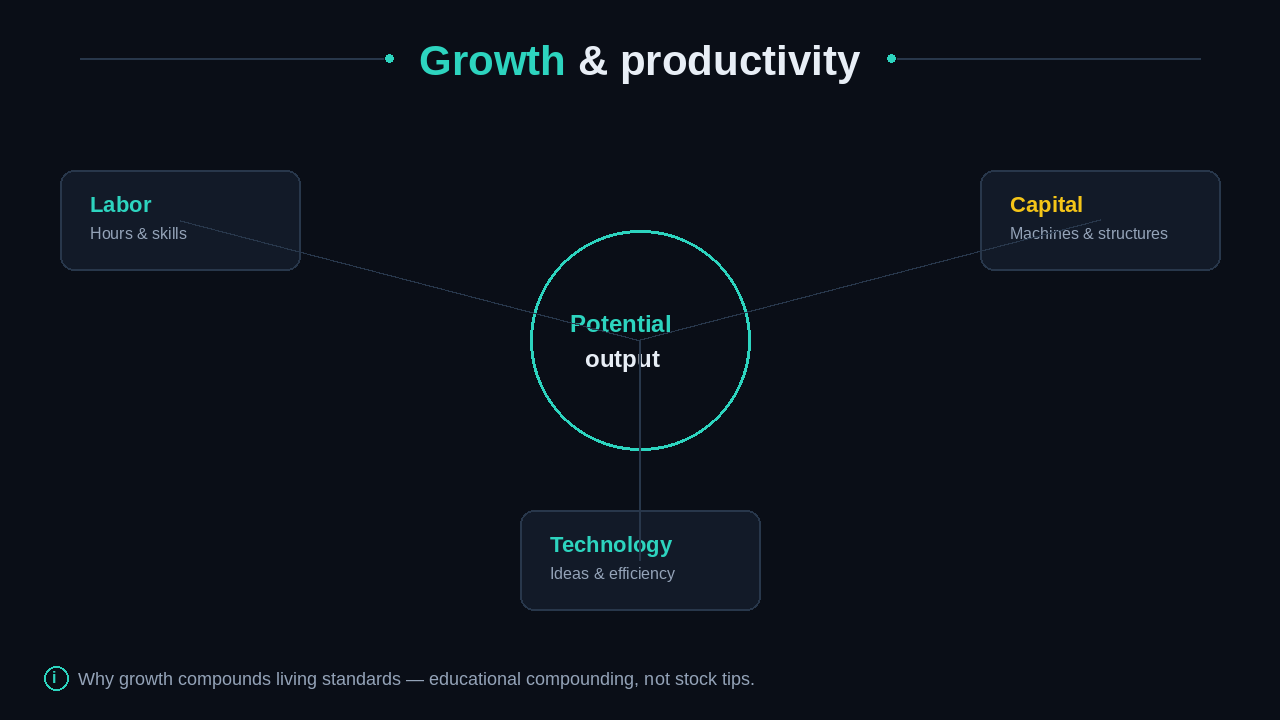
Diagram: labor, capital, and ideas feeding potential output — teaching map.
Short-run weather vs long-run climate
Quarterly GDP wiggles are the weather. Potential GDP / potential output language is closer to the climate—what the economy can sustainably produce given its labor force, capital stock, and technology.
Business-cycle primers (Business cycle, Recession vocabulary) help with the weather. This page is about why living standards rise across decades when productive capacity expands.
The three big inputs (plain English)
Classroom growth stories usually emphasize:
- Labor — how many people work, how many hours, and how skilled they are
- Capital — machines, structures, tools, and infrastructure that make work more effective
- Technology / ideas — better methods, organization, and innovation that raise output per input
Productivity is the efficiency story—often summarized as output per hour worked. When productivity grows, an economy can produce more without simply working more hours.
Why compounding living standards matters
Small differences in trend growth compound enormously over decades—like interest, but for an economy’s capacity. That is why policy debates about skills, investment, research, and institutions show up even when markets are obsessed with next week’s CPI.
For investors-as-learners (not as signal-chasers): long-run growth frames the backdrop for earnings and real incomes. It does not tell you what to buy today. Asset-role vocabulary without recipes: Cash, stocks, and bonds.
Potential vs actual — the gap idea
When actual GDP runs hot above potential for long, inflation debates often intensify. When actual runs soft below potential, slack and unemployment conversations rise (Unemployment types). Measuring potential is imperfect—treat it as a teaching gauge, not a precise GPS.
Next reads
- GDP and how we measure the economy — the scoreboard
- Jobs and growth — near-term labor pulse
- Business cycle — short-run fluctuations around trend
- Demand shocks vs supply shocks — hits to capacity vs spending
- Glossary — potential GDP, productivity
Related reads
Telegram
Growth prints and debates: Join Macro Simplified.