
First 30 days
Educational only. This is a study plan for learning macro vocabulary and habits. It is not a 30-day trading challenge, not portfolio advice, and not a signal calendar.
Site vs Telegram
Read primers here on your own schedule. Open Telegram only when a live FOMC, CPI, or NFP print needs plain-English decoding: Macro Simplified on Telegram.
If you are new to macro—or new to connecting “Fed talk” with stocks and crypto headlines—thirty days of steady reading beats thirty days of hot takes. Below is a week-by-week order. Skim what you already know; linger where the jargon still feels foggy.
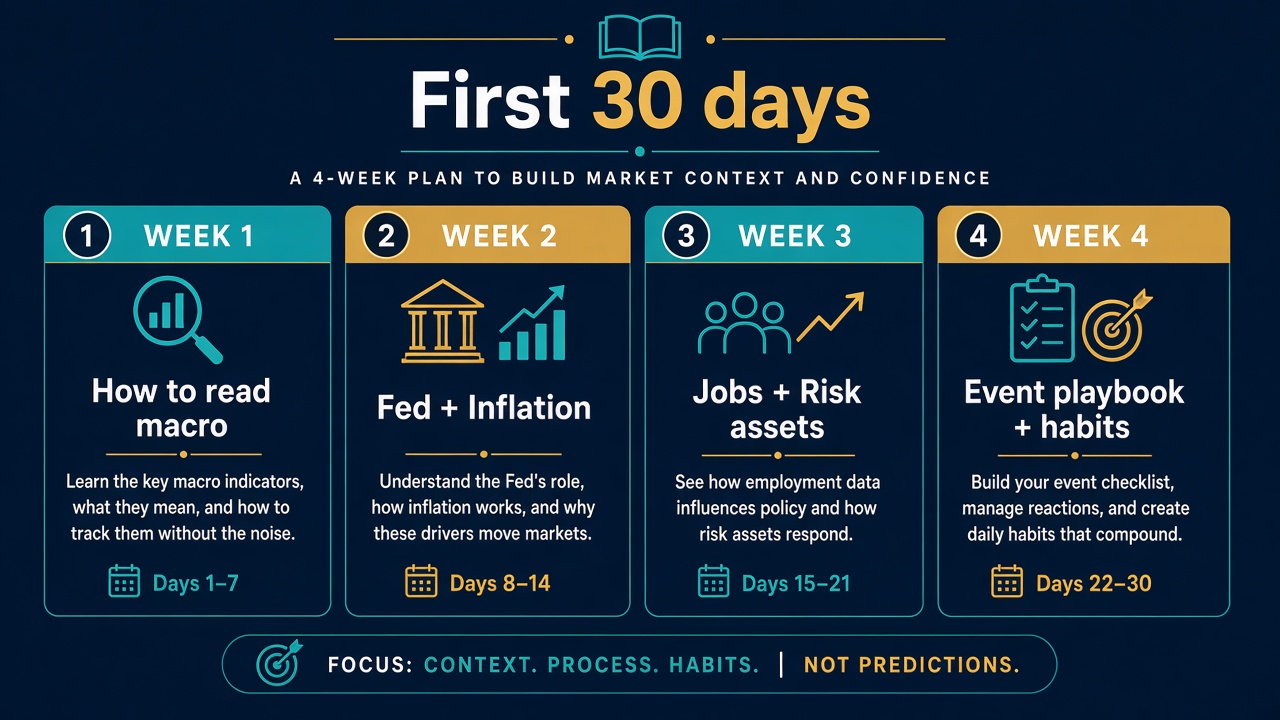
Diagram placeholder: four-week reading path — study map only, not a forecast calendar.
Week 1 — Mindset and the Fed
Goal: Build the four-dials habit and meet the central bank toolkit.
- How to read macro — growth, inflation, policy rates, liquidity as connected dials.
- The Fed toolkit — policy rate, balance sheet (QE/QT language), forward guidance.
- About Macro Simplified — site vs Telegram; what we will never claim.
Habit this week: Before reacting to any headline, name the dial it is really about. Write it down once. That alone cuts panic scrolling.
Week 2 — Prices, rates, and bonds
Goal: Separate inflation measures from bond-yield language.
- Inflation 101 — CPI, core, PCE without trading the print.
- Interest rates and yields — policy rate vs market yields; yield-curve idea.
- Bonds for beginners — price vs yield intuition; duration light.
- Optional skim: Cash, stocks, and bonds — asset roles as vocabulary, not an allocation recipe.
Habit this week: When you see “yields jumped,” translate it once: bond prices fell. No need to act—just decode the sentence.
Week 3 — Growth, cycle, and conditions
Goal: Jobs, cycle language, and “tight vs easy” financial conditions.
- Jobs and growth — payrolls, unemployment, GDP light.
- Business cycle — expansion / peak / contraction / trough as a map.
- Recession vocabulary — soft/hard landing as labels, not dated calls.
- Financial conditions — how rates, credit, and risk mood travel together.
Habit this week: When someone says “recession,” ask: are they describing a past label, a scenario, or a dated prediction? This site stays in vocabulary-and-map mode.
Week 4 — Markets, dollar, housing, habits
Goal: Connect risk mood, the dollar, everyday rate transmission, and calm sources.
- Risk assets 101 — rates, liquidity, risk-on/off—with explicit anti-signal framing.
- US dollar and FX plus Commodities and the dollar — headlines as context.
- Housing, mortgages, and rates — how policy rates show up in mortgage quotes (not real-estate advice).
- Event playbook and Priced in / expectations — calm process for print days.
- Finish with Sources and habits and Common macro myths.
Habit this week: Pick one official source (BLS, BEA, or Fed) and bookmark it. Prefer the primary release over a viral screenshot.
Habit checklist (pin this)
Use this as a monthly reset, not a scorecard for “winning” markets:
- [ ] I can name the four dials without looking them up.
- [ ] I know site = primers, Telegram = live prints.
- [ ] I can say “priced in” without treating it as a trade rule.
- [ ] I separate soft/hard landing labels from forecasts.
- [ ] I open Event playbook before a big release day when I can.
- [ ] I do not treat any primer as a buy/sell instruction.
Miss a week? Resume where you left off. Macro literacy compounds; FOMO does not.
Time box (keep it light)
Aim for two or three short sessions a week, not a second job. One primer thoroughly beats five primers skimmed in a panic. If a live FOMC or CPI day lands mid-plan, pause the curriculum, use the Event playbook, optionally check Telegram, then return to the week you were on.
What Telegram is for (and isn’t)
During these 30 days, Telegram is optional background—not homework. Use it when:
- An FOMC decision, CPI, or NFP print just dropped and you want plain-English context.
- You already read the matching primer and want same-day language, not a replacement for the primer.
Do not use Telegram (or this site) as a signal desk, tipster feed, or “what should I buy today” channel. Educational only.
Keep a simple note file: date, release name, which dial, one sentence of “what people are debating.” Review it at the end of the 30 days. Patterns in your notes teach faster than someone else’s certainty.
After day 30
Re-read How to read macro once. Skim the Glossary for any term that still feels slippery. Then deepen on whichever dial you bump into most in your own newsfeed—rates, inflation, jobs, or the dollar.
| If you want… | Read |
|---|---|
| Fiscal vs monetary | Fiscal policy basics |
| Asset roles without allocation advice | Cash, stocks, and bonds |
| Calm official sources | Sources and habits |
| Myth corrections | Common macro myths |
Live decoding lives on Telegram
When the number hits: https://t.me/MacroSimplified.
Site = durable primers. Telegram = live event decoding.