
Risk, luck, and narratives
Educational only. This primer covers humility tools for reading macro and markets—Taleb-adjacent ideas about luck, skill, and stories. It is not a trading system, not options advice, and not a claim that “everything is random so study is useless.”
Site vs Telegram
Judgment primers live here. Live prints still need calm process on Telegram: Macro Simplified on Telegram.
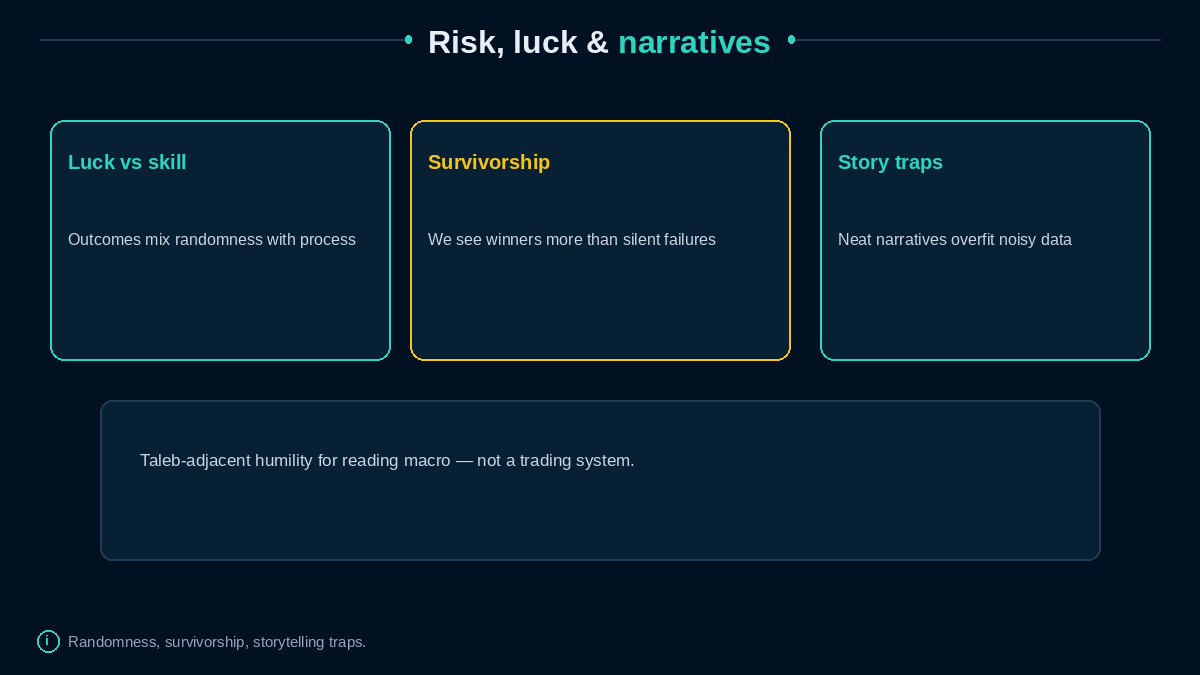
Diagram: Luck vs skill, survivorship, narrative traps — humility tools, not a trading system.
Outcomes mix luck and process
Good decisions can lose; bad decisions can win—for a while. Macro and markets are full of noise, incomplete data, and revisions (Data revisions and nowcasting). Separating process quality from one outcome is a core literacy habit.
This does not mean analysis is pointless. It means single outcomes are weak report cards.
Survivorship
We hear more from winners, famous calls, and surviving institutions than from quiet failures. Histories of “genius timers” often skip the graveyard. When a narrative markets a pristine track record, ask what you are not seeing (Sources and habits).
Narrative traps
Humans prefer neat stories: “the Fed did X, therefore Y.” Sometimes the story is roughly right; often it overfits (Priced in / expectations). Bubble talk, soft-landing talk, and geopolitics talk all invite tidy plots (Bubbles and feedback loops, Geopolitics and risk premiums).
Counter-habit: write the falsifier. What evidence would make you drop the story?
Risk vocabulary without a system
Risk is about distributions of outcomes and exposure to pain—not only volatility numbers. Diversification and regime awareness help as concepts (Diversification and regimes) without this page prescribing weights.
Common confusions
- “Luck means effort is worthless.” Process still compounds learning.
- “A good story equals a good forecast.” Stories persuade; they do not guarantee.
- “Humility is bearishness.” Humility is calibration, not permanent gloom.
- “This page is a strategy.” Explicitly not.
In practice
After a big market day, list: what was known before, what surprised, what story is forming, and what would invalidate it. That journal habit beats screenshot confidence. Keep How to read macro and the Event playbook as process anchors.
Macro storytelling loves single causes: “it was all QE,” “it was all fiscal,” “it was all China.” Complex systems rarely obey one-knob explanations (How to read macro). Prefer layered dashboards—growth, inflation, rates, liquidity—over monotheistic narratives.
Survivorship also biases which frameworks stay fashionable. Ideas that thrived in one regime get over-generalized into the next (Diversification and regimes). When a framework has a hot decade, ask what regime it assumed.
Practice: keep a small error log. Missed calls taught with process notes beat deleted screenshots. That habit is the opposite of a trading system; it is an anti-fragility practice for learners.
Beginner win: prefer checklists and primary sources over charismatic certainty. Charisma scales engagement; calibration scales learning.
Watch for in headlines: genius-call mythmaking after lucky outcomes, and monocausal stories for complex prints. Ask what was invisible (survivorship) and what would falsify the plot.
Base rates help: how often do similar setups resolve the way the story claims? If nobody cites base rates, the narrative may be running on charisma alone.
How this connects
- How to read macro · Common macro myths
- Priced in / expectations · Sources and habits
- Diversification and regimes · Bubbles and feedback loops
Related reads
Telegram
Narrative-heavy macro days: Join Macro Simplified.