
Output gap and potential GDP
Educational only. This primer explains potential GDP and the output gap as teaching estimates. It is not a recession call, not a Fed vote prediction, and not advice to trade growth surprises.
Site vs Telegram
Capacity vocabulary lives here. When “slack” or “overheating” shows up in Fed-speak, Telegram carries the live gloss: Macro Simplified on Telegram.
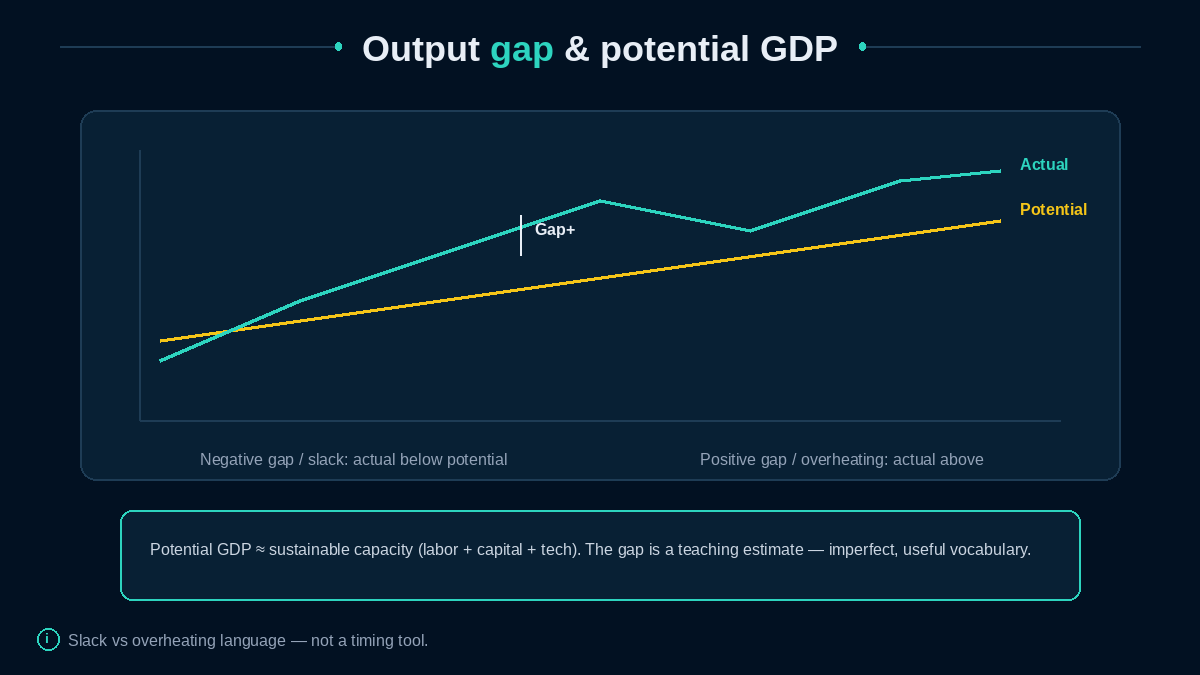
Diagram: Actual vs potential — slack and overheating as vocabulary, not a timing tool.
Potential GDP — the economy’s “climate”
Potential GDP is a teaching estimate of what an economy could sustainably produce given labor, capital, and technology—without overheating inflation pressure. Think climate, not this quarter’s weather.
It is not directly observed like a store receipt. Economists infer it from models, trends, and labor-market gauges. Different institutions publish different paths. That uncertainty is part of the concept—not a reason to throw it away.
Long-run drivers—productivity, labor supply, capital deepening—live in Growth and productivity and, for the AI debate, AI, productivity, and potential growth.
The output gap — actual minus potential
The output gap is roughly actual GDP minus potential GDP (sometimes expressed as a percent of potential):
- Negative gap / slack — actual below potential; unused resources; often softer inflation pressure other things equal
- Positive gap / overheating — actual above potential; strained capacity; often firmer inflation pressure other things equal
“Other things equal” matters. Supply shocks can raise inflation even with slack (Demand shocks vs supply shocks). Sticky services can keep inflation firm while goods cool (Sticky services and shelter inflation).
Why policy talk uses the gap
Central banks and forecasters use gap language when weighing the dual mandate: how hot is demand relative to capacity? A large positive gap story supports “restrictive policy” debates; a deep negative gap supports “supportive policy” debates. This site teaches the words—it does not cast the next FOMC vote.
Measurement cousins include unemployment gaps and capacity-utilization talk. Beginners can stay at the GDP-gap intuition and still follow speeches.
Myths to drop
- “Potential GDP is known precisely.” It is estimated and revised.
- “Positive gap always means hike tomorrow.” Policy rules are judgment plus data, not a single gap print.
- “Zero gap means perfect calm forever.” Shocks still happen; composition of demand and supply still matters.
- “If I learn the gap, I can time recessions.” See Recession vocabulary—labels, not timers.
In practice — hearing “slack” in Fed-speak
When officials say resource slack is still present, they are gesturing at a negative-gap-like story: room to grow without immediate overheating. When they say demand is running hot relative to supply, you are hearing positive-gap language—even if they never say “output gap” aloud.
Translate patiently. Then check whether supply shocks are muddying the inflation side before assuming a textbook Phillips link (Phillips curve for beginners).
Potential output also shifts when labor-force participation, immigration, or capital investment change the economy’s sustainable capacity—topics neighboring Jobs and growth. Treat those as slow-moving ingredients in the potential path, not as day-trading inputs.
How this connects
- Scoreboard: GDP and measurement
- Growth spine: Growth and productivity · Jobs and growth
- Inflation link: Phillips curve for beginners · Inflation 101
- Cycle map: Business cycle
Related reads
Telegram
Growth and capacity language in live prints: Join Macro Simplified.