
Jobs and growth
Educational only. This page teaches how jobs and growth show up in macro conversations. It does not predict recessions, call soft or hard landings as forecasts, or recommend any investment action.
Site vs Telegram
Use this primer to understand labor and growth vocabulary. For live NFP and related jobs-day decoding, join Telegram: Macro Simplified on Telegram.
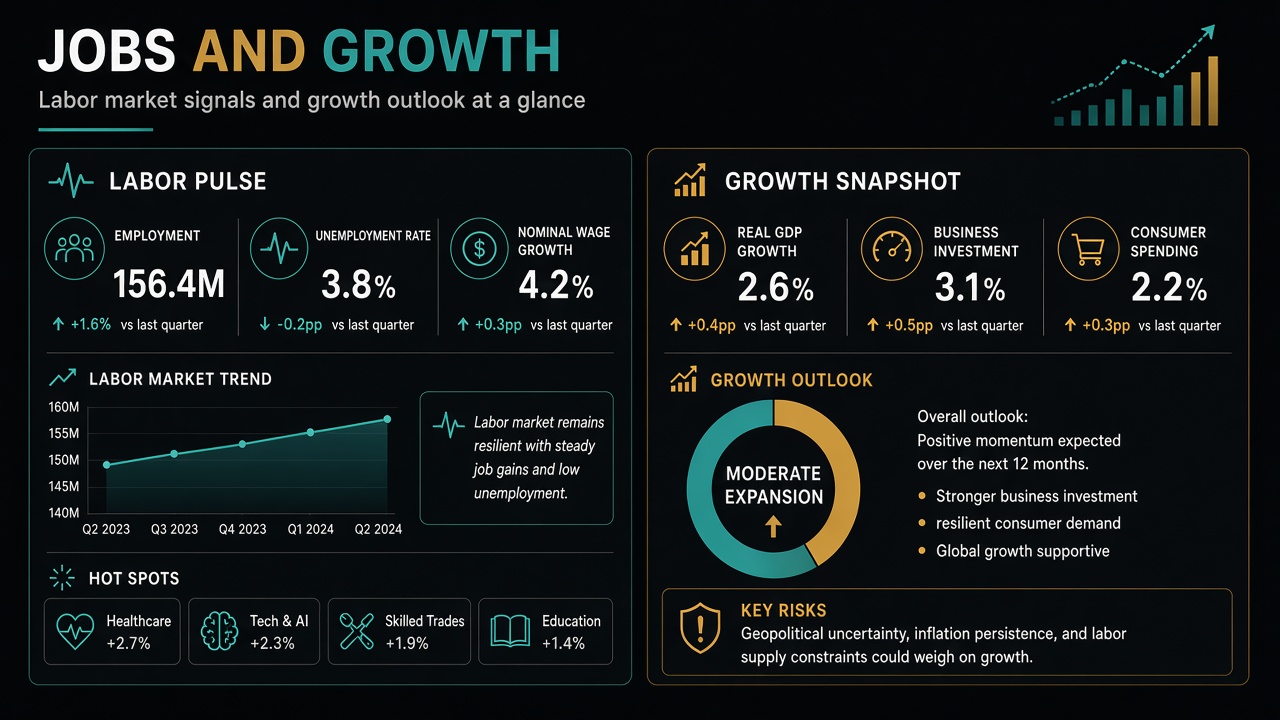
Diagram placeholder: jobs and growth as the economy’s pulse — scenarios, not forecasts.
Why jobs matter
Jobs sit at the center of the Fed’s dual mandate alongside stable prices. When more people who want work can find it, household income and spending tend to hold up. When hiring stalls or unemployment rises sharply, growth usually softens and policy debates shift.
For everyday readers, “jobs matter” is not abstract:
- Paychecks support consumption—the largest slice of the U.S. economy.
- Tight labor markets can feed wage growth, which can feed into inflation stories (see Inflation 101).
- Loose labor markets can ease wage pressure but signal weaker demand.
Investors watch jobs because the Fed watches jobs. That does not mean every payrolls beat is a buy signal or every miss is a sell signal. It means labor data is one of the main inputs to the policy path—and therefore to financial conditions.
The job numbers you’ll see
A few labels dominate the monthly conversation:
Nonfarm payrolls (NFP)
The headline change in jobs outside farming. It answers: roughly how many jobs were added or lost last month? Revisions to prior months often matter as much as the fresh print.
Unemployment rate
The share of the labor force that is jobless and looking for work. It can fall because hiring is strong—or because people leave the labor force. Context beats the single number.
Wages (average hourly earnings and related measures)
Wage growth feeds cost stories for firms and income stories for households. Hot wages with hot inflation read differently than hot wages with cooling prices.
Labor force participation and other detail
Participation, part-time for economic reasons, job openings (from other surveys), and claims data fill out the picture. Beginners can start with payrolls, unemployment, and wages, then layer detail as curiosity grows.
On release day, use the Event playbook process and Telegram for the live read—not a rush to “position.”
Growth without textbook fog
Growth here means how fast the economy’s output and spending are expanding or contracting. The broad scoreboard many people cite is GDP (gross domestic product)—the value of goods and services produced.
You do not need the full national-accounts textbook. Hold three plain ideas:
- Demand — households, businesses, government, and net exports buying stuff.
- Capacity — workers, factories, and supply chains able to produce that stuff.
- Momentum — whether activity is firming, cooling, or mixed across sectors.
Surveys (sentiment, purchasing managers’ indexes), retail sales, industrial production, and GDP each illuminate corners of the same elephant. Macro literacy is noticing whether the cluster of signals leans hot, soft, or muddy—not memorizing every series.
Soft landing vs hard landing (scenarios not forecasts)
You’ll hear landing metaphors whenever inflation has been high and policy has tightened:
- Soft landing — Inflation cools toward the Fed’s comfort zone while growth slows only modestly and the labor market softens without a deep downturn.
- Hard landing — Cooling inflation (or forcing it down) comes with a sharp rise in unemployment and a clear recession-style contraction.
- No landing / re-acceleration — Growth stays firm or picks back up and inflation progress stalls (language varies by commentator).
These are scenario labels for organizing debate. They are not predictions on this site, and this page will not assign dates to recessions or landings. Real economies are messier than the metaphor: sectors can soft-land while others struggle; data can flip for a few months and confuse the narrative.
When someone claims “soft landing confirmed,” treat it as an opinion about the path—not as a fact you must trade.
Into the Fed’s lens
Through the Fed’s dual-mandate lens, jobs and growth interact with inflation roughly like this:
- Very hot labor + sticky inflation → more concern about demand running ahead of supply; tighter policy stays in the conversation.
- Cooling inflation + still-solid jobs → the soft-landing hope many officials and investors discuss.
- Rising unemployment + falling demand → growth risks climb; the balance of risks in forward guidance can shift even if inflation is not fully settled.
Again: that is a map of how the debate is framed, not a script for the next FOMC move. For the tools themselves, read The Fed toolkit.
Event tie-in (NFP)
NFP Friday (when the employment situation lands) is one of the three event types in the Event playbook, alongside FOMC and CPI.
Before the print: skim this page and know which pieces you’ll watch (payrolls, unemployment, wages, revisions).
During/after: separate the data from the narrative; use Telegram for same-day plain-English decode; resist turning a one-month jobs number into a multi-year forecast.
Growth data like GDP arrives on its own calendar. Apply the same calm process—primer open, live channel for the day, no signal language from this site.
Related reads
Telegram
NFP and jobs-day decoding: Join Macro Simplified.