
Demand shocks vs supply shocks
Educational only. This primer builds shock vocabulary. Historical examples are teaching stories—not forecasts, not trade ideas, and not personalized advice.
Site vs Telegram
Shock frameworks stay here. Same-day print decoding belongs on Telegram: Macro Simplified on Telegram.
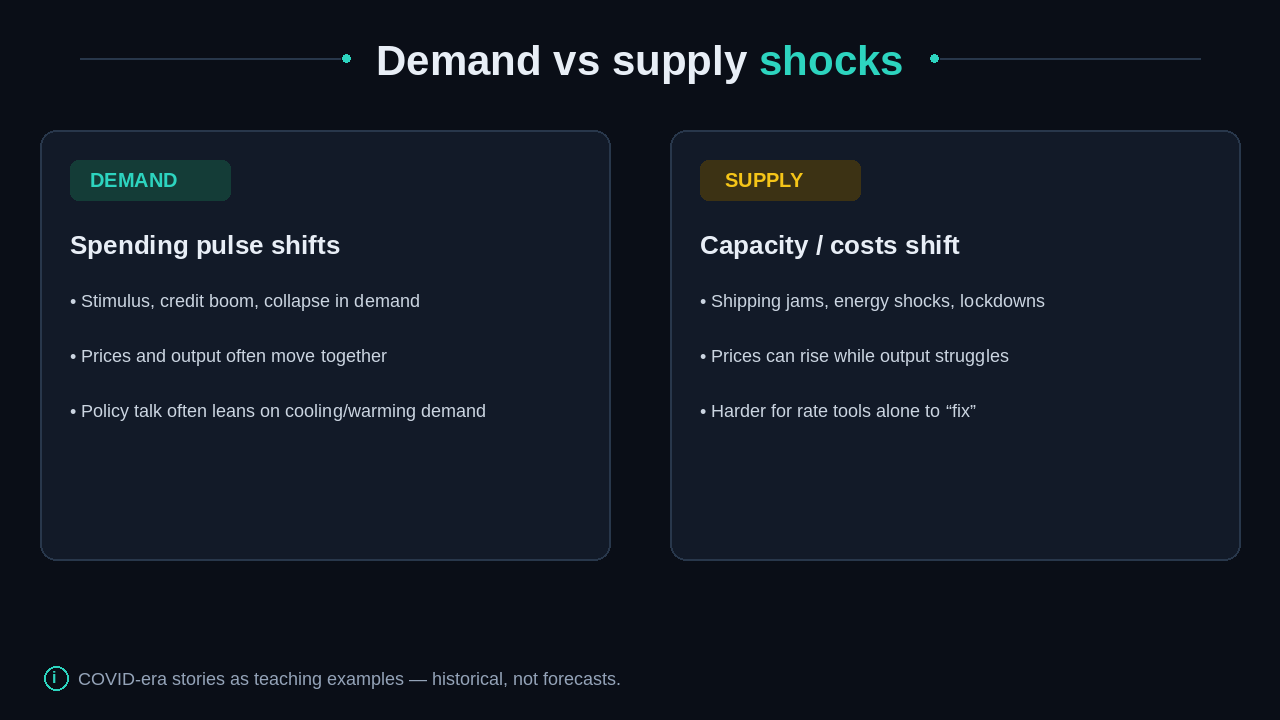
Diagram: spending-pulse vs capacity/cost shocks — classroom map only.
Why “shock” language helps
Macro headlines often sound like one big fog: prices up, growth soft, markets jumpy. Economists sort many surprises into two families:
- Demand shock — a sudden shift in spending appetite (too much or too little demand chasing goods and services)
- Supply shock — a sudden shift in capacity or costs (harder or costlier to produce and deliver)
You will also hear AD/AS (aggregate demand / aggregate supply) in undergrad courses. You do not need heavy graphs here—just the vocabulary: demand is about spending; supply is about the economy’s ability to produce at given costs.
Demand-side stories
Demand can jump when incomes, credit, confidence, or fiscal support surge—or collapse when households and firms slam the brakes.
In a pure demand story, output and prices often lean the same direction: hot demand → more activity and upward price pressure; cold demand → softer activity and cooler price pressure. Policy debates then often focus on cooling or supporting demand (including via rates—see The Fed toolkit).
Link the inflation classroom versions in Inflation 101 (demand-pull vs cost-push).
Supply-side stories
Supply shocks hit the ability or cost of producing: energy spikes, shipping jams, factory closures, crop failures, sudden regulatory or geopolitical disruptions.
In a classic adverse supply story, prices can rise while activity struggles—an uncomfortable mix for any central bank. Rate tools that cool demand do not instantly rebuild a port or refill an oil market. That is why identifying the mix of shocks matters more than chanting one slogan.
COVID-era teaching examples (historical)
Use these only as labels for learning, not as predictions of the next regime:
- Early pandemic: lockdowns smashed both demand (services) and supply (operations, logistics).
- Later phases: snarled supply chains and goods demand shifts showed up in prices while labor markets and fiscal/monetary support shaped the demand side.
- Reopening waves mixed catch-up demand with lingering supply constraints—textbook “both can be true.”
The skill is asking: Is today’s print mostly a spending story, a capacity/cost story, or a blend? For growth measurement beside shocks, see GDP and measurement. For ugly inflation-plus-weak-growth vocabulary, see Disinflation, deflation, and stagflation.
Next reads
- Inflation 101 — demand-pull vs cost-push
- Jobs and growth — labor as a pulse check
- Business cycle — shock → cycle language
- Inflation regimes — stagflation vocabulary
- Glossary — demand shock, supply shock
Related reads
Telegram
Live growth and inflation prints: Join Macro Simplified.