
Trade and the balance of payments
Educational only. This primer teaches trade and payments vocabulary. It is not FX advice, not a trade recommendation, and not a political campaign for tariffs or free trade.
Site vs Telegram
Trade explainers live here. Live dollar and data decoding belongs on Telegram: Macro Simplified on Telegram.
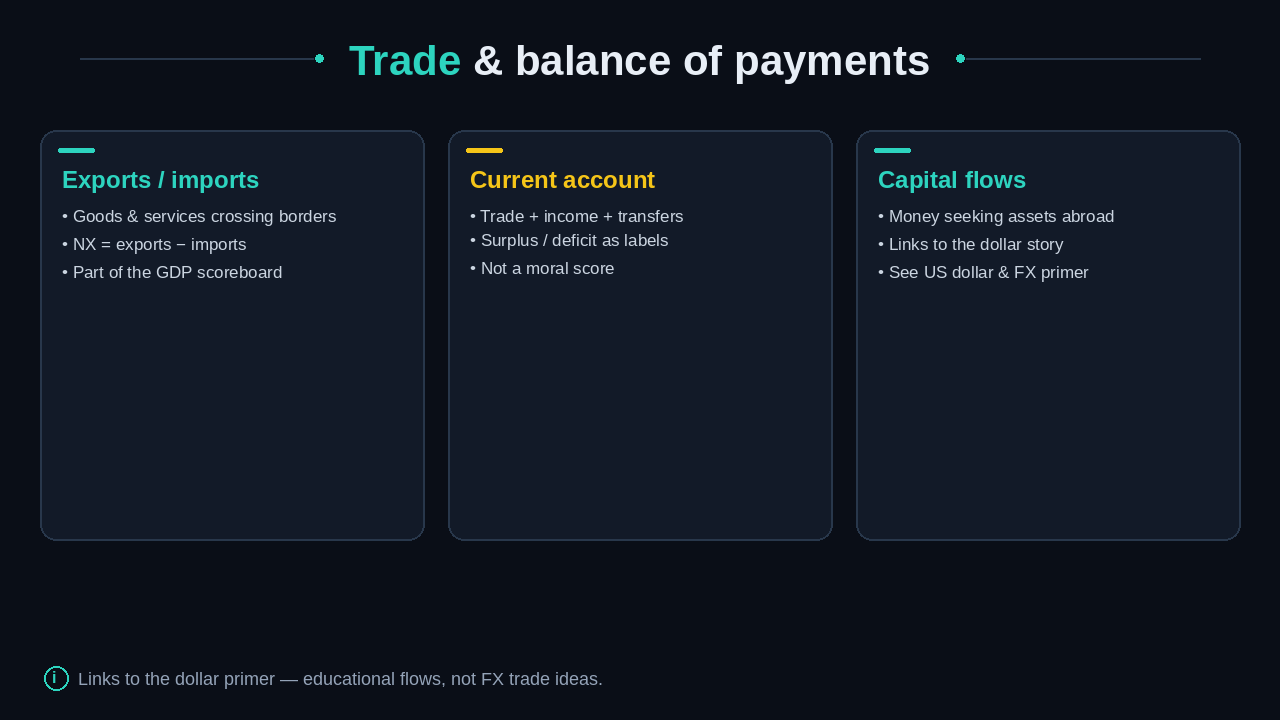
Diagram: trade, current account, and capital flows — map only, not an FX desk.
Exports, imports, and net exports
- Exports — goods and services sold to foreigners
- Imports — goods and services bought from abroad
- Net exports (NX) — exports minus imports; one bucket inside GDP
A trade deficit in goods and services means imports exceed exports for that measure—an accounting label, not a moral failing by itself. Context always matters: strong domestic demand can pull in imports; weak foreign demand can soften exports.
Current account (plain English)
The current account is a broader snapshot than merchandise trade alone. In teaching language it folds in:
- Trade in goods and services
- Primary income (like cross-border investment income)
- Secondary income / transfers
People shorthand “current-account deficit/surplus” in headlines. Treat those as balance-sheet flow labels, not automatic market signals. Official detail lives with national accounts and balance-of-payments releases (see Sources and habits · BEA).
Capital flows intuition
When a country buys more from the world than it sells (in current-account terms), something on the financing side usually balances the books: capital flows—money moving into assets, loans, or reserves.
You do not need to master every line of the financial account. You need the habit: trade and capital flows are linked, and both show up in dollar stories. A stronger or weaker dollar changes the local-currency price of imports and the competitiveness of exports—details in US dollar and FX and Commodities and the dollar.
Why macro learners care (still not FX tips)
Trade and payments language helps you decode:
- GDP contributions from NX
- Inflation talk when import prices swing
- “Twin deficits” style commentary (fiscal + current account) as debate vocabulary, not a trading system
Fiscal side: Fiscal policy basics. Growth side: Growth and productivity.
Next reads
- US dollar and FX — stronger/weaker dollar context
- GDP and how we measure the economy — NX in the scoreboard
- Commodities and the dollar — traded goods prices
- Fiscal policy basics — deficit vocabulary nearby
- Glossary — current account
Related reads
- US dollar and FX
- GDP and how we measure the economy
- Commodities and the dollar
- How to read macro
- Glossary
Telegram
Dollar and trade-related prints: Join Macro Simplified.